
Career Research and Frameworks
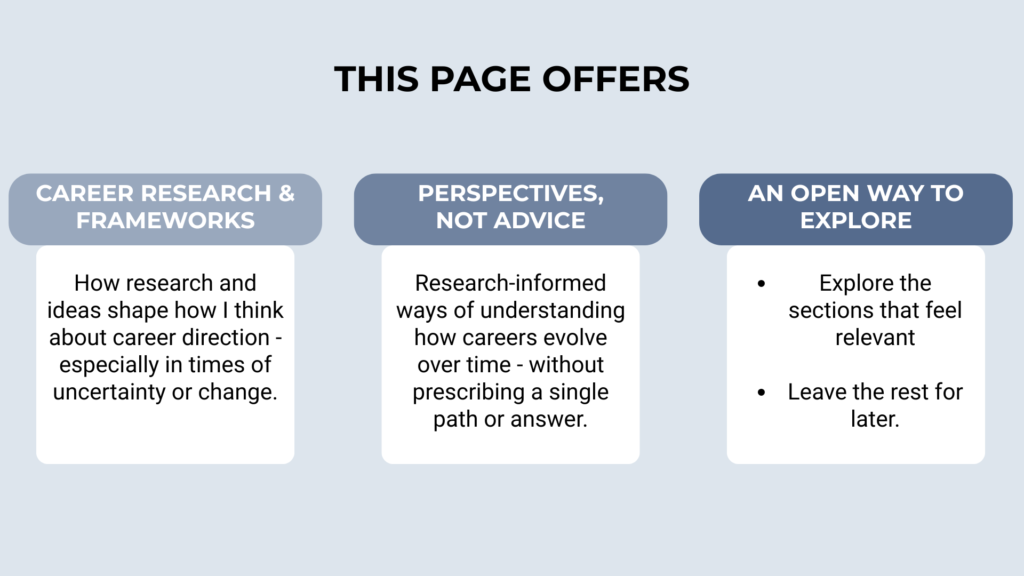
This space shares research and ideas that shape how I think about career direction – especially in times of uncertainty or change.
It’s not advice or a set path, but a collection of perspectives that reflect how careers evolve over time. You don’t need to read these to benefit from career coaching, but they’re here if you’re curious about the thinking behind the approach. If you are looking for something practical that you can immediately apply in your current context, go to Getting Oriented: A First Step.
Below, you’ll find simple summaries and links to explore more, if and when it feels useful.
A Visual Framework for Career Direction:
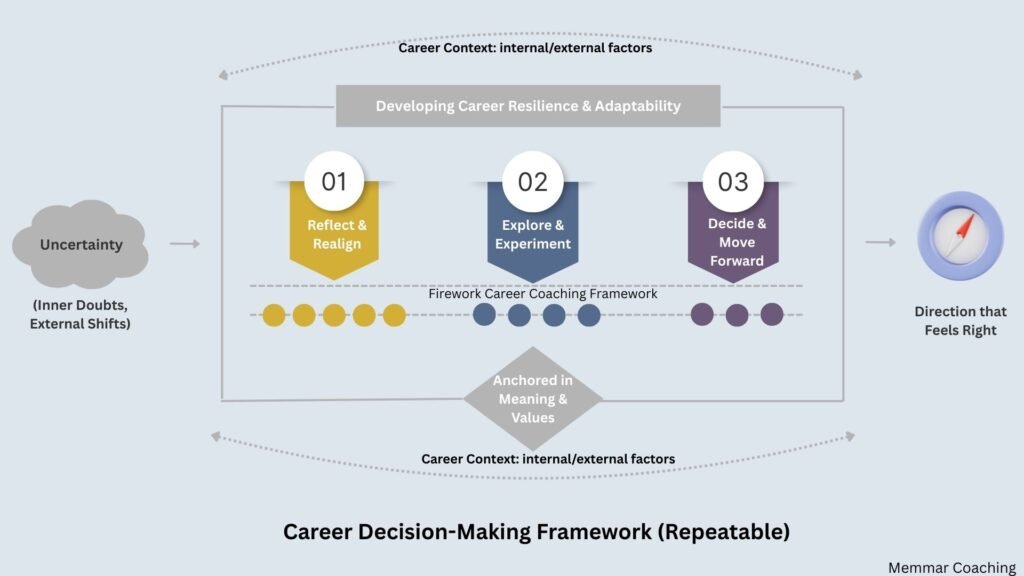
This framework brings together several research-informed ideas to reflect how career clarity can evolve over time – especially when you’re not rushing toward a single answer.
Some notes on references:
- A complete list of references is available at the end of this page.
- The references shared here represent selected research perspectives rather than an exhaustive list, and this collection will continue to evolve over time.
- Selected references are also shared via Google’s NotebookLM as a working research space.
- In the Notebooks, some summaries, video or audio are AI-generated based on the original sources. For full context and accuracy, please consult the primary materials.
- Most of the research available and consulted are from the Western context and they may not fully represent experiences globally.
Careers in Context
What it is
Careers are shaped within systems. The Systems Theory of Career map shows how personal factors (e.g. values, health, identity, skills) interact with family, communities, workplaces, markets, policy, media, and history – across past, present, and future. It’s a lens for seeing careers as co-constructed, rather than purely individual.
Why it matters
Recognizing context helps mid-career professionals move more wisely through uncertainty: it reduces self-blame, clarifies what’s within influence versus constraint, and points to useful supports – so decisions are grounded in context rather than a one-size-fits-all approach.
Research Links
(See “Contemporary Career Theories” below)
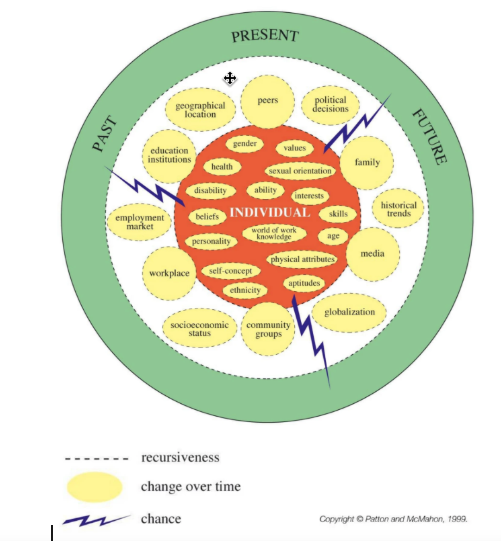
The Systems Theory Framework of Career Development (from Patton & McMahon, 1999) – link to the image.
Uncertainty
What it is
Uncertainty is a normal condition of modern careers. It means acting with incomplete information – about options, timing, or direction. It often shows up as over-thinking/over-researching, holding too many options open, or avoiding decisions altogether – not because there are no options, but because there isn’t yet enough evidence to choose responsibly.
Why it matters
Faster change, non-linear paths, and overlapping demands from work, life, technology, and systems raise the stakes of decision-making. Learning how to move with enough to act, rather than full certainty, helps people keep moving without needing everything figured out.
Research links
Uncertainty – NotebookLM source pack (v2026.02 – 4 sources)
Decision-Making Under Uncertainty
What it is
Making career choices when information is incomplete. Good decision practice here means exploring more than one possible direction, clarifying what matters before narrowing options, and learning through small, deliberate steps – rather than waiting until everything feels certain.
Why it matters
In fast-changing, option-rich environments, how decisions are made matters as much as what is chosen. A thoughtful process – one that explores, compares, and tests options – increases the likelihood of choices that feel both sustainable and right for the person making them.
Research links
Several contemporary career theories offer useful ways of approaching decisions in complex, messy contexts (see Contemporary Career Theories below).
Career Resilience and Adaptability
What it is
Two related capacities that help people navigate work over time.
Resilience is about handling difficult periods – finding ways to steady yourself, recover after setbacks, and keep going when things are difficult.
Adaptability is about staying open and responsive – noticing what’s changing, exploring options, and adjusting direction when needed.
Both are shaped by personal circumstances and the systems people work within.
Why it matters
Careers today rarely move in straight lines. Change, disruption, and shifting demands are part of the landscape. Being able to adjust and recover supports continued participation in work, and wellbeing.
Research links
Career Resilience & Adaptability – NotebookLM source pack (v2026.02 – 6 sources)
Contemporary Career Theories
What it is
Different ways of thinking about how careers take shape over time, especially when change and uncertainty are part of the picture. Refer to the descriptions of various theories below.
Why it matters
When paths aren’t linear, having more than one way of making sense of careers helps people choose next steps that feel realistic and grounded
Research links
Contemporary Career Theories – NotebookLM source pack (v2026.02 – 12 sources)
Protean Career Model
What it is
An approach to careers that puts personal values and inner fit at the centre. Instead of measuring success mainly by titles, status, or external approval, it emphasises whether work feels aligned with who you are and how you want to live.
Careers, in this view, are shaped over time through learning, changes in identity, and the ability to adapt across different roles and settings.
Decision-making lens
When choosing between options, pay attention to what aligns with your values and your own definition of success – especially when external signals, trends, or expectations feel noisy or conflicting.
Chaos Theory of Careers
What it is
A way of understanding careers as complex and non-linear. Rather than following a clear plan, careers are shaped by many interacting factors – including chance events, unexpected encounters, and small changes that can lead to new directions over time.
In this view, patterns often become clear only in hindsight.
Decision-making lens
Instead of trying to plan everything upfront, focus on small experiments and staying open to what emerges. Pay attention to patterns that start to repeat or gain energy, rather than searching for a perfect long-term plan.
Career Construction Theory
What it is
A way of understanding careers as something people actively shape over time through the stories they tell about their lives and work. In this view, careers are built by making sense of past experiences, noticing recurring themes, and adjusting as roles and priorities change.
Choices are guided not just by opportunities, but by meaning – how different paths fit with who you are becoming.
Decision-making lens
Explore possible versions of yourself and try steps that feel consistent with your story so far – and with the roles you want to grow into next.
Systems Theory Framework
What it is
A way of understanding careers as shaped by many interacting systems over time. Personal factors (such as values, health, skills, and identity) interact with family, workplaces, communities, policies, and broader social conditions. Career direction develops within this web of influences, not in isolation.
This framework helps make visible what’s supporting you – and what may be constraining you – across past experiences, current realities, and future possibilities.
Decision-making lens
Before choosing a next step, take time to notice the systems around you. Clarify what’s within your influence, where support exists, and where constraints are real – then focus your energy where it can actually make a difference.
Kaleidoscope Career Model
What it is
A way of understanding careers as a series of rebalancing acts. At different points in life, people tend to place different weight on three needs:
- feeling true to themselves
- having enough balance between work and life, and
- feeling stretched or challenged by their work.
Which of these matters most can shift with life circumstances, responsibilities, and priorities.
Decision-making lens
When considering options, notice which need is most present right now. Choose the move that best fits this phase of your life, rather than trying to optimise everything at once.
Social Cognitive Career Theory
What it is
A way of understanding how people develop career interests, make choices, and take action based on three main factors:
- what they believe they can do
- what they expect might happen if they try, and
- the goals they set for themselves.
These are all shaped by the supports and barriers present in their environment.
In other words, confidence, expectations, and context interact to influence career direction.
Decision-making lens
When considering next steps, pay attention to what feels possible right now. Notice where confidence could be strengthened, what outcomes you’re hoping for (or worried about), and how real supports and constraints shape your options. Choose goals that fit both your inner readiness and your context.
Sustainable Careers
What it is
A way of thinking about careers over the long term. A career is considered sustainable when it supports health, feels like a good fit, holds meaning, and allows movement or adjustment over time – across different roles, life stages, and contexts.
This perspective applies both to individuals and to organizations that want careers to be workable and durable, not just productive in the short term.
Decision-making lens
When weighing options, look beyond immediate gains. Consider how a choice affects your health, sense of fit, meaning, and ability to adapt over time – so short-term wins don’t come at the expense of longer-term wellbeing or viability.
Meaningful Work (Context)
What it is
Meaningful work is the experience of feeling that what you do matters – that it connects with your values, fits with your sense of self, and has some significance beyond the task itself. It isn’t a single “dream job” or a permanent state, but a quality of experience shaped over time by the work you do, the relationships around you, leadership, and the wider system you’re part of.
Meaning is something that is co-created, not discovered once and for all.
Why it matters
In changing and uncertain environments, a sense of meaning can act as a steady reference point – helping people decide what to pursue, what to sustain, and what to let go of. It’s linked to motivation, energy, and wellbeing.
At the same time, research also points to a dark side of meaningful work. When meaning is idealised or left unexamined, it can lead people to tolerate poor conditions, overwork, or misalignment in the name of purpose. That’s why meaningful work needs to be considered alongside health, boundaries, and context – not treated as the only goal.
Research links
Meaningful Work – NotebookLM source pack (v2026.02 – 9 sources)
Career Development in Organizations: A Shared Responsibility
What it is
An approach that treats career development as a partnership. Individuals take an active role in shaping their direction, while organizations create the conditions that support this – through psychological safety, autonomy, learning opportunities, mentoring/coaching, transparent mobility, and meaningful career conversations.
The aim is sustainable careers for people and an adaptable, capable workforce for organizations.
Why it matters
As work becomes more complex and changeable, self-directed career management is increasingly important – but it works best when organizational support is present. Research shows that when both are in place, people tend to experience higher engagement and satisfaction, while organizations benefit from stronger performance and lower burnout and turnover.
Research links
Career Development in Organizations – NotebookLM source pack (v2026.02 – 4 sources)
Intentional Change Theory (ICT) - Framework
What it is
Intentional Change Theory (ICT) is not a career theory in itself. It is a theory of sustainable, self-directed change that explains how people move toward meaningful change over time.
Developed by Richard Boyatzis, ICT describes change as a non-linear, iterative process that begins with clarifying what matters (one’s “ideal self”), followed by honest reflection on current reality, small experiments, and ongoing learning – supported by relationships and emotional engagement.
Rather than focusing on fixing gaps or forcing outcomes, ICT emphasizes direction, intention, and learning through action.
Why it matters
In career decisions – especially mid-career – people are rarely just choosing roles. They are navigating identity shifts, values, energy, and competing responsibilities.
ICT matters because it:
– Explains why lasting change rarely comes from pressure, willpower, or urgency
– Validates starting with direction and intention rather than certainty or plans
– Supports small, low-risk experiments instead of irreversible decisions
– Highlights the role of emotions, relationships, and reflection in change
– Helps people work with complexity without needing a fully formed answer
In practice, ICT provides a human, evidence-based foundation for working toward clarity when the next step is unclear – making it especially relevant for career direction, learning, and leadership development.
Research links
Intentional Change Theory – NotebookLM source pack (v2026.02 – 4 sources)
Firework Career Coaching Framework
What it is
The Firework Career Coaching Framework is a practical, licensed framework based on research in career evaluation and transition. I integrate it to bring structure to career exploration. It helps surface what matters to you, generate a small number of realistic options, and try them out in real life – without requiring you to learn theory or adopt a fixed model.
Why it matters
When careers feel uncertain or complex, having a light, repeatable structure can make it easier to keep moving. This framework supports a simple rhythm – reflecting, trying small experiments, shaping options, and deciding next steps – while staying attentive to values, constraints, and real-world conditions.
Research links
This is a practice tool. For some of the research that informs the ideas it incorporates, see these sections:
- Uncertainty
- Career resilience & adaptability
- Contemporary career theories
- Careers in context
- Meaningful work in context
- Intentional change theory
Full List of References
This full list of references also includes sources not available in NotebookLM.
UNCERTAINTY
CAREER RESILIENCE AND ADAPTABILITY
Not available in NotebookLM
CONTEMPORARY CAREER THEORIES
14. Dziak, M. (2024). Social cognitive career theory (SCCT). Research Starter. EBSCO.
Not available in NotebookLM
MEANINGFUL WORK (CONTEXT)
CAREER DEVELOPMENT IN ORGANIZATIONS: A SHARED RESPONSIBILITY
Not Available in NotebookLM
INTENTIONAL CHANGE THEORY (ICT) – A FRAMEWORK