
Coaching at Memmar
Coaching can mean many things. Two people could have very different understanding of coaching based on their experiences.
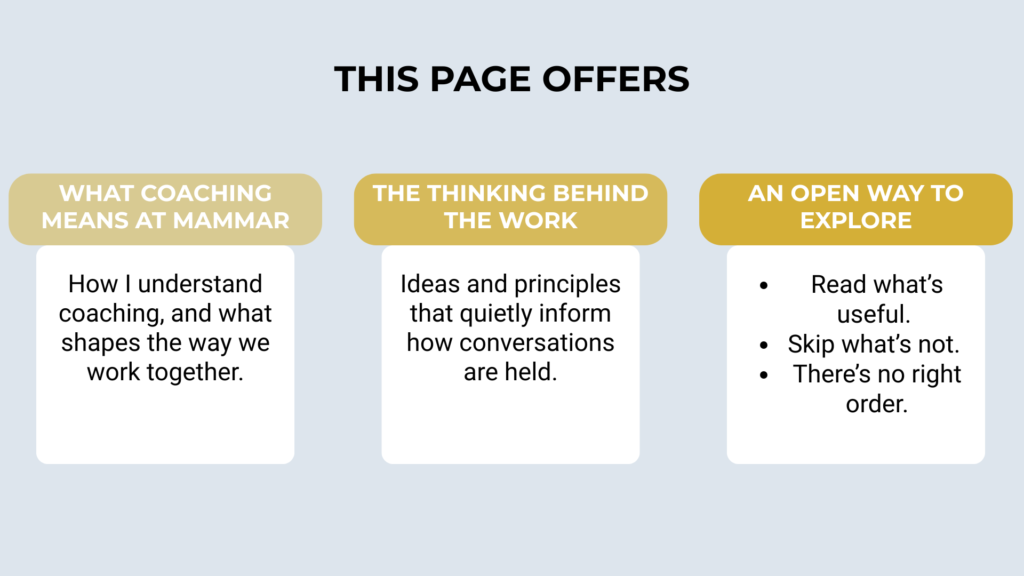
This page shares what coaching means here at Memmar – how I work, what shapes my approach, and the principles behind the conversations we have.
You don’t need to know the theory about coaching to benefit from it. But if you’re curious about the thinking beneath this work, this is a good place to start.
If you are looking for something practical that you can immediately apply in your current context, go to Getting Oriented: A First Step.
What is Coaching? The Foundational Principles
Coaching is more than a conversation – it’s a reflective space for change where you can slow down your thoughts.
At its core, coaching is a partnership that supports learning, clarity, and meaningful forward movement. The International Coaching Federation defines coaching as:
“Partnering with clients in a thought-provoking and creative process that inspires them to maximize their personal and professional potential.”
That definition can sound abstract at first.
In everyday terms, coaching is a focused conversation that helps you:
- understand where you are and what matters to you
- reflect on patterns, choices, and possibilities
- make decisions and take action that feel aligned
To support access in different formats, this video was generated using AI tools. The full text is also available in this NotebookLM.
The full text remains the primary reference. It talks about:
- what coaching is (and what it is not)
- the theories that underpin professional coaching
- how these principles show up in real coaching conversations
Coaching isn’t about giving advice or fixing problems.
It’s about learning more about yourself – and from there, navigating work and life with more clarity, intention, and a sense of ease.
Rather than teaching or advising, coaching supports reflection on real-life situations, helps surface patterns and assumptions, and creates space for insight to emerge through experience. It also recognises that growth happens within real-world contexts – shaped by work, relationships, and systems – not in isolation.
Why coaching works (in brief)
Coaching is grounded in decades of research on how adults grow, learn, and change. While there are many coaching approaches and methods, professional coaching draws from a shared foundation of the following well-established theories (Bachkirova et al., 2024).
These include:
- Adult learning principles
- Adult learning theory (Andragogy) – Malcolm Knowles
- Experiential learning theory – David Kolb
- Transformative learning theory – Jack Mezirow
2. Systems and complexity theories
These theories explain why coaching focuses on reflection, real-life experience, and self-directed learning – rather than instruction or advice.
You don’t need to understand these theories to benefit from coaching.
Their value lies in how they quietly shape the quality of attention, inquiry, and partnership within the coaching space.
Rather than offering quick fixes, coaching works with real situations, lived experience, and the complexity of people’s lives – supporting awareness, agency, and more considered action over time.
Reference:
Bachkirova, T., Cox, E. and Clutterbuck, D. (eds.) (2024) The Complete Handbook of Coaching. 4th edn. London: SAGE Publications.
Who is Memmar For?
Memmar Coaching is designed for mid-career professionals navigating crossroads.
You may not call it a “career change.”
You may not even be looking for coaching yet.
But if you’re rethinking what work means to you – and quietly wondering what comes next – this space is for you.
You might find Memmar valuable if:
- You’ve built a solid career over the past 7–15 years
- You expect to keep working for another 20+ years
- You’ve outgrown earlier ambitions, roles, or definitions of success
- You’re balancing work and life across complex roles, cultures, or responsibilities
- You’re caring less about external markers – and more about meaning, energy, and alignment
Memmar exists to support this phase – with space to reflect, realign, and choose your next step with intention.
What Memmar Focuses On
The heart of this work is clarity of direction – not quick fixes or tactics.
At Memmar, coaching supports you to:
- Reconnect with what matters to you, beyond titles, roles, or expectations
- Understand what’s driving your restlessness – and what you’re starting to question
- Explore possible directions without pressure to decide immediately
- Design low-risk, thoughtful steps toward work that feels meaningful and sustainable
This work isn’t about starting over.
It’s about slowing down to hear yourself more – and moving forward from there.
What Memmar Does Not Focus On (At First)
Your exploration may eventually involve practical steps like resumes, job applications, or interviews – but that’s not where we begin.
Coaching at Memmar does not initially focus on:
- CV or resume review
- Interview preparation
- LinkedIn optimisation
- Job-search strategy
If and when those become relevant, you’ll be guided to the right tools or experts.
First comes clarity.
And an honest exploration of what you want this next phase to be.
Why Direction Needs a Process
When a career no longer feels clear, it can seem as if a complete answer is needed before any movement is possible.
But meaningful direction rarely arrives as a perfect plan. It develops gradually through reflection, exploration, real-world feedback, and thoughtful choices.
Direction matters because it gives uncertainty somewhere to go. It helps focus attention, reduce scattered effort, and create a clearer reference point for decisions.
A process matters because reflection alone can keep questions circling, while action without reflection can lead to reactive choices.
At Memmar, direction is approached as something that develops through structure, reflection, and real-world learning – not through pressure or quick fixes.
For more on how Memmar supports this in coaching, see below Memmar’s Integrated Approach to Career Direction.
Memmar's Integrated Approach to Career Direction
Memmar’s Integrated Approach to Career Direction combines structure and reflection to support meaningful career decisions – especially when you’re unsure what comes next.
It brings together three elements:
- Clarifying what matters – understanding what feels meaningful and non-negotiable in your current context
- Learning through experience – using small, real-world steps to discover what actually resonates
- Working with what gets in the way – exploring the patterns, assumptions, and responses that shape how decisions are made
These elements come together differently depending on the type of support, and more fully over time.
My Coaching Philosophy
- People are inherently resourceful
Every person is unique and already holds a wealth of inner resources. Coaching doesn’t impose answers. It creates space for these insights to emerge.
2. Coaching is a space for self-understanding
Beyond achieving goals and making decisions, the heart of coaching is about learning more about ourselves so we are better equipped to navigate our challenges with intention.
3. Coaching works best with aligned action
Reflections and insights work best when they are coupled with aligned action.
4. Coaching strengthens how we relate
Coaching has a ripple effect. I believe that incorporating a coaching approach in our work and lives makes our experiences better.
5. Depth begins within
I am always a work-in-progress. I believe that I can only support others to the depth I’ve met myself.
Why a Non-Directive Approach Matters at Memmar
At Memmar, coaching is not about advice, motivation, or being told what to do. It’s about helping you think more clearly about what matters and what comes next.
My role is to offer a reflective space, structure and frameworks, as appropriate – not pre-determined answers.
This approach is especially relevant in mid-career, where the challenge is rarely a lack of ideas, but making sense of complexity without oversimplifying it.
Why this matters:
- You stay in control – decisions are grounded in your values, context, and priorities.
- Complexity is respected – ambiguity and mixed signals are part of the work, not something to rush past.
- Clarity lasts – insights that emerge from your own thinking tend to stay longer.
Non-directive doesn’t mean passive. I challenge assumptions, and bring structure in service of your goals.
What Kind of Support is Relevant for You?
How to Choose the Right Type of Support
If you’ve been considering support but aren’t sure whether to work with a coach, therapist, mentor, or consultant, you’re not alone. There are many forms of professional support, and in practice they often overlap – which can make the choice feel confusing.
Each approach serves a different primary purpose. None is “better” than the others. What matters is what best supports you right now. These forms of support are also not mutually exclusive – many people benefit from using more than one, either sequentially or at the same time, depending on context.
Below, each approach is described in its core form, even though real-world practice may blend elements.
To support access in different formats, this video was generated using AI tools from the written content in this section. The full text remains the primary reference.
Consulting – Structured Expertise
Consultants are engaged to analyse a situation and offer expert recommendations based on specialised knowledge.
- Focus: Solutions, strategy, expert guidance
- Style: Directive; informed by domain expertise
- Helpful when: You need clear answers, frameworks, or recommendations in a specific area
Mentoring – Perspective Through Experience
Mentors support learning through their own lived experience in a particular field or path. Mentoring often includes advice and storytelling alongside reflection.
- Focus: Long-term development, perspective, career navigation
- Style: Relational; experience-informed guidance
- Helpful when: You want insight from someone who has “been there”
Note: Mentoring is not about age or hierarchy – expertise and relevance matter more than seniority.
Coaching – Reflective, Forward-Oriented Growth
Coaching is a structured, collaborative process that supports clarity, learning, and intentional action. Rather than giving advice, coaching helps you think more clearly, surface what matters, and decide your own next steps.
- Focus: Insight, direction, learning, and movement
- Style: Non-directive and reflective; led by your agenda
- Helpful when: You are functioning well but feel stuck, unclear, or ready to explore change with focus and structure
Coaching supports thoughtful reflection and learning that lead to clearer, more considered action.
Therapy – Psychological and Emotional Support
Therapy focuses on mental health, emotional wellbeing, and healing. It can involve working with past experiences, present functioning, and – where relevant – future goals.
- Focus: Mental health, emotional processing, healing
- Style: Clinical; grounded in psychological training and models
- Helpful when: You’re experiencing distress, overwhelm, or patterns that significantly affect daily functioning
Therapy and coaching can sometimes work side by side, depending on your needs and the professionals involved.
Coaching and Therapy – A Helpful Distinction
While both involve reflection and a supportive relationship, their primary aims differ.
Both coaching and therapy can involve emotional depth. In coaching, emotions are explored to support awareness, meaning, and intentional direction – not clinical treatment. Coaching focuses on learning and forward movement; therapy focuses on mental health and healing.
Coaching focuses on learning, clarity, emotional awareness, and forward movement
Therapy focuses on mental health, emotional healing, and psychological care
Mental health exists on a spectrum, and people move along it over time. If you’re unsure what kind of support fits best, that uncertainty itself can be explored with a professional.
A Few Questions to Help You Decide
- Are you feeling emotionally overwhelmed or struggling day to day? → Therapy may be the right starting point.
- Are you generally well but feeling unclear, stuck, or at a crossroads? → Coaching may help.
- Are you looking for guidance based on lived experience? → Mentoring could fit.
- Do you need expert recommendations for a specific problem? → Consulting may be appropriate.
At Memmar
At Memmar, coaching supports people who are willing to reflect, realign, and take meaningful next steps in their work – without being told what to do.
If you’re unsure whether coaching is the right fit, you’re welcome to book a free introductory call. We can talk through your situation and see what kind of support would serve you best – even if that turns out not to be coaching.
How to Make the Most Out of Your Coaching Session
Coaching is a reflective partnership. While there’s no “right” way to show up, a bit of intention can make the experience more meaningful.
Why this matters
Most change doesn’t happen during the session itself – it happens in how you sit with insights afterward and try things out in real life. Sessions often spark clarity, but momentum grows between them.
To support access in different formats, this video was generated using AI tools from the written content in this section. The full text remains the primary reference.
What to consider
You don’t need to be fully prepared or clear. These simple practices can help:
- Check expectations
Coaching isn’t advice-giving. The value comes from discovering your own insights, with structure and support.
- Reflect ahead, if helpful
You don’t need clear goals – just a sense of what feels worth exploring.
- Protect the space
Choose a quiet setting and allow a few minutes before and after to arrive and process.
- Work on what matters to you
The most useful sessions focus on what feels genuinely important – not what you think you should work on.
- Stay open to discomfort
New perspectives can feel unfamiliar. A bit of friction is often part of learning.
- Choose a coach who feels like a good fit
Trust matters. If it doesn’t feel right, keep exploring – fit matters more than format.
If you’re unsure where to begin, the free Getting Oriented: A First Step can be a helpful starting point.
Exploring Thoughts and Feelings
Exploring Thoughts and Feelings
Thoughts and feelings each offer useful information. In my experience, learning to work with both can deepen understanding.
Why this matters
In some professional environments, rational thinking is praised while emotional awareness is often dismissed or avoided. Yet learning to work with both is a valuable skill – and one that can be developed.
To support access in different formats, this video was generated using AI tools from the written content in this section. The full text remains the primary reference.
Our responses to situations are often shaped not only by what we think, but also by how those situations register for us emotionally and physically. Subtle physical cues and emotional reactions often carry information that isn’t immediately available in words. Paying attention to them can expand how we make sense of what’s happening.
Thoughts are valuable. They help us make meaning, plan, and decide. At the same time, they are often interpretations – shaped by past experiences, beliefs, expectations, and context, not just by the present moment.
This means that some thoughts reflect what is happening now, while others reflect familiar stories or assumptions we’ve learned over time.
For example, you might think:
“I could never be good at that.”
That thought might point to a real limitation – or it might simply echo a belief you’ve carried for years. Learning to notice the difference can help clarify what’s actually going on and support more grounded choices.
What gets in the way
Our minds could be creative – and sometimes protective. Without noticing, we can fall into habitual thinking patterns that quietly shape how we see ourselves or our options.
Some familiar examples include:
- All-or-nothing thinking (“If I don’t do it perfectly, I’ve failed.”)
- Should statements (“I should be further along by now.”)
- Mind reading (“They must think I’m not good enough.”)
- Overgeneralising (“I always mess things up.”)
When these patterns go unnoticed, they can influence our decisions, actions, and sense of possibility – often without us realising it.
What can help
One way to gain clarity is by paying attention not only to your thoughts, but also to your emotional responses and the physical cues that accompany them – not to act on them impulsively, but to consider what they might be signalling.
In my experience, emotional reactions and physical cues often provide early information about what’s happening beneath the surface. They can point to discomfort, misalignment, pressure, or even genuine interest – signals that structured analysis alone may overlook.
This doesn’t mean expressing every emotion in the moment. Emotional regulation matters. But in a reflective space – like in coaching – allowing emotions and the physical dimension of experience to be present can deepen understanding.
Even naming what you notice – beyond broad labels like “stressed” or “anxious” – such as where tension shows up or when energy drops, can gradually shift awareness.
Why this belongs in coaching
Coaching offers a supportive space to slow down and explore both thoughts and feelings without judgment.
You don’t have to prioritise one over the other. From my perspective, insight often deepens when thoughts, emotions, and physical cues are held together.
This matters most when you’re trying to make sense of a professional situation that feels more complex than it appears on paper.
My coaching work is informed by in-depth, ICF-accredited training in working with emotions and body-based awareness. Within coaching, this supports clients to notice subtle signals, increase self-awareness, and connect insight with lived experience – always in service of learning, clarity, and intentional forward movement.
Ethics in Coaching
Ethics in Coaching
Coaching often involves personal questions, real experiences, and meaningful professional decisions. Because of that, it benefits from a clear ethical framework.
My work at Memmar is guided by the International Coaching Federation (ICF) Code of Ethics. This framework supports clarity, professionalism, and respect throughout the coaching process.
What ethical guidance means in practice
A clear ethical foundation helps to:
- Clarify expectations around the coaching relationship
- Define roles and responsibilities from the outset
- Protect client autonomy and decision-making
- Maintain appropriate professional boundaries
- Ensure confidentiality in line with ICF guidelines
Ethics does not make coaching rigid. Rather, it provides structure – creating a space that is transparent, respectful, and grounded.
Ongoing supervision and professional development are also part of my commitment to practicing responsibly and thoughtfully.
If you ever have questions about how coaching works, its scope, or what to expect, those conversations are always welcome.
Accountability Partners
The Value of Accountability Partners
Knowing what to do doesn’t always mean we’ll do it. And that isn’t necessarily a sign of laziness or lack of discipline.
Sometimes we are clear about what matters to us. We may even know the next step. Yet translating intention into action can still feel harder than expected.
This is especially true during periods of professional transition or uncertainty. When we’re navigating change, we’re often holding multiple questions at once – about direction, stability, identity, or timing. Acting in the middle of that complexity requires more than clarity. It requires support for follow-through.
To support access in different formats, this video was generated using AI tools based on the written content in this section. The full text remains the primary reference.
What gets in the way
Many of us carry quiet self-judgment about needing support. It can feel as though we should be able to move forward independently once we’ve “figured things out.”
But reflection and action are different capacities. Often, insight does not automatically generate momentum. You might recognize this pattern. And meaningful progress often doesn’t happen in isolation.
Having someone alongside us does not signal incapability. It can simply provide support that helps intention translate into movement.
What can help
Coaching is one way to get that support. A dedicated coaching space offers regular pauses to reflect, clarify, and reconnect with what matters, while staying attentive to the realities of your professional context.
Family and friends can offer meaningful encouragement and perspective. At the same time, their closeness and shared history may shape how situations are interpreted. A neutral coaching space can create room to examine your thinking without needing to reassure, defend, or justify. That distance can support clearer perspective.
Coaching, however, is not the only form of accountability.
A peer accountability partner can support follow-through in a different way. Rather than offering structured exploration, a peer partnership can provide shared commitment and regular check-ins as you test ideas or act on insights.
Each form of support serves a different function. Together, they can strengthen both clarity and consistency.
What a peer partnership can look like
An accountability partner can simply be someone who is also exploring their own professional questions.
Together, you might:
- Set small, meaningful intentions
- Check in regularly at a pace that suits you
- Offer encouragement without pressure
- Reflect on what’s working and where support is needed
→ You don’t need a formal setup for this. Even one person you trust can be a steady sounding board as you reflect.
Reflective Practice
A Reflective Practice
A simple and practical way to learn about ourselves.
Reflective practice is often an overlooked way we make sense of our experiences and learn from them. It plays an important role in coaching and offers a quiet way to reconnect with ourselves.
We move through life responding, deciding, and adjusting – often without pausing to learn from what’s happening. Reflective practice creates that pause. It helps us make sense of experience and respond with greater awareness and choice.
To support access in different formats, this video was generated using AI tools based on the written content in this section. The full text remains the primary reference.
What is reflective practice?
Reflective practice is the intentional process of thinking about our experiences – noticing what happened, how we felt, what we learned, and what it might mean going forward.
It’s not about overthinking. It’s about making meaning.
This might look like:
- reflecting on a conversation or decision
- journaling about an emotional moment
- mapping how we handled a challenge and what we noticed
Over time, these small pauses add up – helping us spot patterns, clarify values, and strengthen trust in our own judgement.
Why it matters
Regular reflection strengthens self-awareness and contributes to more considered decisions.
Reflective practice helps us:
- process experiences more fully
- notice inner responses, not just actions
- learn without judgment
- adjust with intention
In coaching, reflective practice supports us to slow down and hear our own thinking – especially when the path ahead feels unclear.
Reflection alone – and with others
Private reflection is powerful, but has its limits. We all have blind spots.
That’s why reflection often deepens in conversation – with a trusted peer, a coach, or even well-designed AI prompts. Shared reflection can:
- surface new perspectives
- gently challenge assumptions
- reveal what’s easy to miss alone
Together, inner reflection and dialogue create a fuller picture of our experience.
How to start
Reflective practice doesn’t need to be complicated:
- You might begin by setting aside short, quiet time
- Some people use a simple structure or prompt
- Writing or sketching can help map your thoughts
- let it be imperfect – progress matters more than polish
Reflection is central to how coaching works at Memmar. It’s not about overthinking, but about creating space to notice what’s happening beneath the surface – patterns, tensions, and signals that are easy to miss in the rush of daily work. Sometimes that reflection happens in a session. Sometimes it happens through writing, or in the pause between one decision and the next.
The goal isn’t productivity.
It’s connection – to yourself and what matters.
If you’d like a gentle place to begin, Getting Oriented: A First Step offers a structured way to pause, reflect, and reconnect with where you are in your career journey.
The Value of Virtual Spaces for Personal & Professional Development
Why This Work Is Designed to Be Virtual at Memmar
There’s often an assumption that meaningful learning only happens face-to-face. Physical presence can be powerful – but it isn’t the only way learning happens, especially when the work is reflective rather than instructional.
Personal development often benefits from space, pacing, and privacy. Insight doesn’t always come on demand. It emerges as you pause, sit with questions, and notice what’s happening in real life.
A virtual format supports this kind of work by:
- Allowing reflection to happen in your own time, not only during scheduled sessions
- Creating space between moments of insight, where meaning can settle and evolve
- Making learning easier to integrate into life as it is, rather than separating it into a “special” setting
For reflective work, depth doesn’t depend on proximity alone. It’s created by attention, continuity, and the ability to return to questions as they develop.
For this reason, Memmar is intentionally designed as a primarily virtual space.
How Virtual Work Happens at Memmar
At Memmar, virtual doesn’t mean distant or transactional. It allows reflective work to stay connected to your real context.
The virtual format makes it possible to:
- Access resources when it fits your rhythm, not just at fixed times
- Continue reflecting between sessions, rather than confining insight to a single conversation
- Engage in coaching conversations without the added friction of travel or time off
Optional supports – such as peer connection or AI-based reflective tools – are offered as complements, not requirements. You choose what supports your process and what doesn’t.
This isn’t about doing more on a screen.
It’s about creating conditions where reflection can happen steadily, thoughtfully, and in a way that fits your context.
The Use of AI at Memmar
Coaching at Memmar is based on partnership, and creates space for reflection and learning. That remains the foundation of the work.
Alongside this, I’m exploring how generative AI can optionally support reflection between sessions – not as a replacement for human connection, but as a simple support for continued thinking.
Why I use AI
Reflection doesn’t always need to happen with another person present. For some people, AI can offer a gentle space to think aloud.
Used carefully, AI can offer reflective questions and highlight patterns in your responses.
At Memmar, I also use AI to edit, refine and produce media, so that what reaches you is clear, well-structured and generated in different formats.
Optional and transparent
AI is not mandatory at Memmar.
It’s used only with your consent.
You’re free to try it, ignore it, or step away at any time.
Some people find it helpful. Others don’t. Both are equally welcome.
What AI does – and doesn’t – do
At Memmar, AI can offer structure, curiosity, and provides a consistent format for reflection. It does not:
- Replace human connection
- Make decisions for you
- Provide therapeutic support
You remain the decision-maker. AI simply supports your thinking – when and if you choose to use it.
Why it belongs here
Reflection isn’t one-size-fits-all.
Sometimes you need a structured place to begin. An AI-supported prompt can help you organize your thoughts – at your own pace.
If you’re curious, you can experience this through Getting Oriented: A First Step, where light, optional AI support is available at your own pace.
Curious how this works or whether it’s right for you? The Frequently Asked Questions page may help.